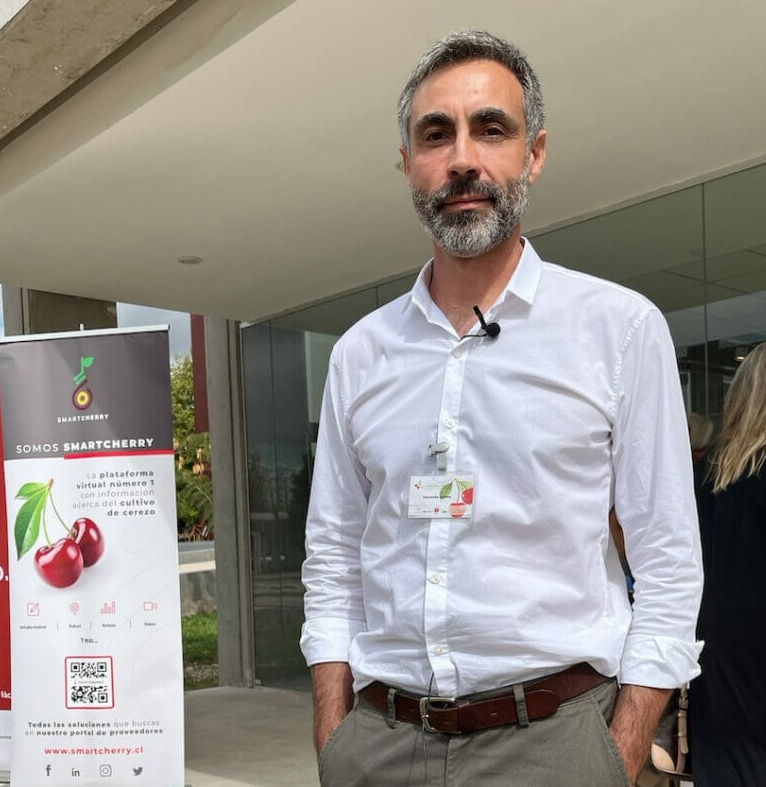

Late spring rains have created a favorable environment for the proliferation of Drosophila suzukii; what do the specialists say? We spoke to Dr. Karina Buzzetti about this.
The fly Drosophila suzukii has become a major concern for the cherry industry in various regions of the world. Originally from Asia, this invasive species has generated significant alarm due to its ability to attack ripe fruit, especially cherry and berry crops, affecting their yield and quality.

Unlike other flies of the same genus, Drosophila suzukii The female has a particularly worrying characteristic: its ability to lay eggs in healthy, ripe fruit. The female can pierce the skin of the fruit and deposit her eggs inside, resulting in the infestation of larvae in the fruit. This process causes direct damage to the fruit tissue and leads to decay, reducing its quality and commercial value.
Cherry trees are particularly susceptible to these attacks, as ripening fruits are the preferred targets of this fly. As cherry trees enter the ripening phase, they become more vulnerable to infestation, resulting in significant losses.
for producers.
The difficulty lies in the early detection of the presence of Drosophila suzukii, since the fly can damage fruit before harvest, complicating control efforts. Late rains in spring have created a favorable scenario for the proliferation of Drosophila suzukiiKarina Buzzetti, PhD in Agricultural Sciences and Director of the Agri Development Consulting Firm, explains why.
“High relative humidity, whether natural or artificial due to the use of microjets in irrigation and the use of roofs, allows for an increase in relative humidity in the air, which makes the conditions for copulation favorable for this insect. Flight is favored because adults, which have quite delicate wings, suffer less from the dehydration of these wings and therefore have a greater probability of meeting males and females. Consequently, there is greater pressure for ovipositions in fruits.”.

The critical period in cherries occurs from straw colour onwards. In other species, the onset of the attack is associated with the colour change, which marks the softening of the fruit or a greater accumulation of sugars or change in protein content.
"If there are fruits that are softer than others or with a weaker cuticle than others, the fly will always
will prefer to lay eggs in those that are weaker," added Dr. Buzzetti.
Challenges in control
Traditional pest control methods may be insufficient against this invasive species. The resistance of Drosophila suzukii certain insecticides and their short life cycle present additional challenges for management.
“Capturing Drosophila suzukii adults is always easier in winter, because the traps available on the market are food traps that compete in their attraction power with the fruit itself. Therefore, if you have fruit at the beginning of the ripening period, it will be more common for the adults to be concentrated on attacking the fruit, and therefore the traps at that time may be marking low to zero capture of adults, which can be misleading in interpretation,” warned the Doctor of Agricultural Sciences.

Regarding recommendations for the management of Drosophila suzukiiDr. Buzzetti indicated that there are excellent alternatives, but you have to know how to use them well.
“For example, after a rainy event, obviously fungicide treatments must be carried out in conjunction with insecticide treatments; today there are several alternatives that we should be able to order by chemical group, highlighting, but not excluding, the use of other tools. I would highlight those products from the pyrethroid group and within them, especially, those that come in encapsulated suspension formulations such as the brands Karathe® Zeon, Invicto® CS or Ninja® 050 CS and Bull®; then the spinosyn group where products such as Entrust®, Success® or Delegate® stand out and the diamides group, among which Exirel® stands out. These would be the three main groups that I would highlight, without excluding that there are other pesticides from different chemical groups or that are presented in mixtures that are also highly useful against Drosophila suzukii.”, he pointed out
the specialist.
In addition to conventional control strategies, such as the use of insecticides or the removal of damaged fruit, innovative and sustainable approaches are being sought. Biological control strategies are being explored, including the use of natural enemies, such as other predatory insects.
In addition, more precise monitoring methods and advanced technologies are being developed to detect and address the presence of this pest more efficiently.
Ongoing research plays a crucial role in finding long-term solutions. Understanding the biology, behavior, and ecology of Drosophila suzukii It is essential to develop more effective and specific management strategies. “It is important to remember that you should always respect the dosage, route of application and other indications on the label." concludes the specialist.
Images: Avium.