By: Héctor García O., Co-Founder and General Manager of Diagnofruit Laboratories Ltda, SOCHIFIT and AMICH Member. hgarcia@diagnofruit.cl
Without a doubt, within the nightmares of a producer or technician dedicated to fruit growing, horticulture or floriculture, one of the worst is the “ATTACK OF GRAY ROT”, starring our well-known Botrytis ““Freddy Krueger” cinerea. Yes ok In recent years we have met other sinister characters such as Botrytis “Jason Voorhees” pseudocinerea either Botrytis “Michael Myers“ prunorum, The truth is that these variants do not manage to dominate the productive systems, therefore B. cinerea It continues to be the object of control and the focus of the phytosanitary program, as we will review later.
Years ago, when cherries had not yet become the most important export species in Chile, we were dealing with cultivars with a short post-harvest life; I remember Early Burlatt, Sam, Summit, Newstar, with very short, soft optimal harvest windows and a very high susceptibility to rot, especially grey rot; because of this, it was common to receive complaints, even on air trips.
Today varieties with better performance dominate. performance and less susceptibility to fungal attacks, such as Santina, Regina, Kordia, an advance that allows us to sleep a little more peacefully. Hand in hand with the development of varieties, the packaging lines have also been improved, and control systems for sanitizers and fungicides on the line have been perfected, which contributes a little more to our good sleep.
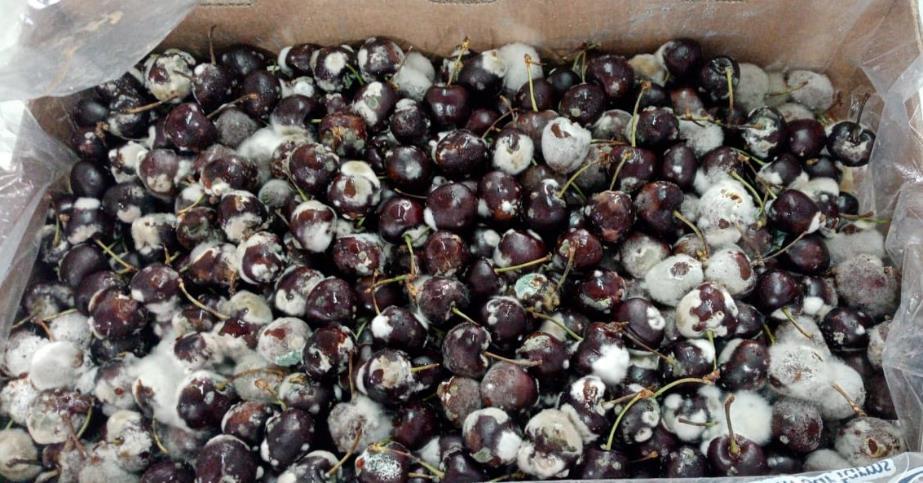
However, as the title mentions, gray rot is a critical point in cherry production that we must never stop controlling and errors in the field, packing and climatic anomalies are becoming more recurrent (Photo 1).
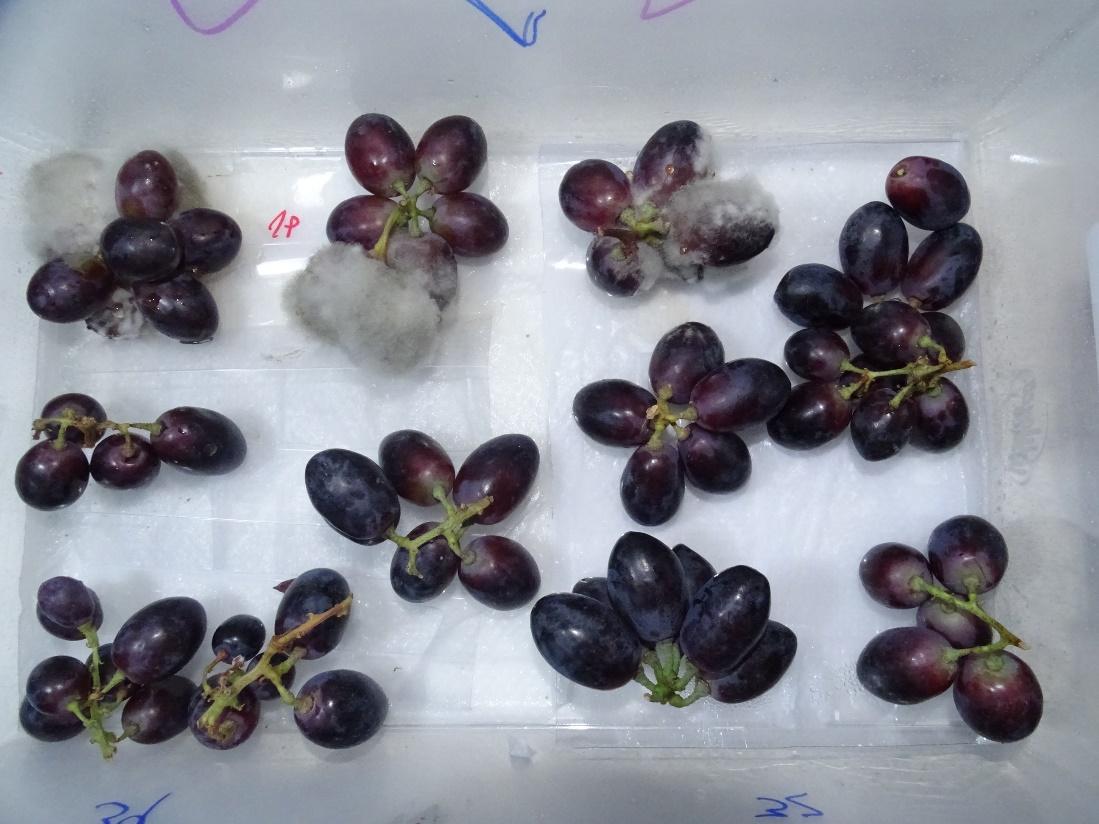
“Zen” Cherries
We have talked tirelessly in other articles, talks, field conversations, that the first factor we must worry about is the production of fruit in balance “Zen” This creates a virtuous circle of quality, condition and lower environmental impact. In exploratory studies that we have carried out in conjunction with the Cherry Committee, we have realized that nitrogen in the fruit, which is generally associated with over-fertilization, alters the balance with elements such as calcium, generating fruit that is more susceptible to rot. Another factor that generates imbalance is overproduction; we must establish productive ceilings realistically for each plot, otherwise we do not reach good sizes, we present problems of hardness, poor soluble solids, and delays in maturity, all indications that the plant is working under pressure and, most likely, has more fruit than it can support.
In addition to the problems mentioned above, this fruit is more susceptible to rot, generally has less calcium and more nitrogen, hand in hand with a reality: those orchards that produce the most are also those that apply the most units of nitrogen, because the extraction calculations are often carried out in a standardized way and without taking into account the local reality, such as the contributions of nitrogen through irrigation water.
Another area that we are studying, which could be an important factor in imbalance, is the indiscriminate use of growth regulators, especially those applications carried out very late in the development of the fruit, when the producer analyses that the size is falling below expectations. In this way, for example, we have observed a certain connection between the late use of cytokinins and susceptibility to rot, especially in shelflife.
As mentioned, generally, when an orchard overproduces, it applies more nitrogen and at the same time uses more growth regulators, in order to increase the size, this undermines the construction of a balanced cherry, becoming an easy victim for Botrytis.
Important: every year perform mineral concentration analysis of the fruit.
Pre-harvest control
While the control of Botrytis The classic cherry control begins in flowering, its objective is to attack blossom blight, and it has very little contribution to the control of gray rot in pre and post-harvest of fruits, unlike what happens in other species such as grapes, where the application of blossom is very relevant. Chemical or biological control of Botrytis, Considering gray rot, it should begin with the onset of straw color, from that moment on, applications can result in decreases in the frequency of fruits with rot upon receipt and after refrigerated storage.
Today we have the possibility of integrating various chemical groups for the specific control of Botrytis, carboxamides such as boscalid, fluopyram or penthiopyrad, hydroxyanilide such as fenhexamid, or the phenylpyrrole fludioxonil are tools to take into account in the critical stage described, always considering deficiencies and limitations of residues by destination.
Some botanical extracts, such as quillay or citrus, in addition to having a certain degree of control over Botrytis, have an elicitor effect, which contributes to generating fruits that are more “resistant” to infection. Like biocontrollers, such as Bacillus either Trichodermas, plant extracts should be scheduled with more than one application from color break; elicitor effect must be “turned on” at least a couple of times to generate a larger and more stable response over time.
We must also apply biocontrollers several times during the season, because in some way the idea is to occupy the space, hinder the development of fungi such as Botrytis, beyond processes of parasitism on the pathogen, therefore, Continuous inoculation is a fundamental technique for the success of this type of formulations.
Resistance to fungicides, the hidden weapon of Botrytis
F
Reddy Krueger fed on our fears and exposed them through nightmares, thereby managing to eliminate several protagonists in each of the successive installments of the saga. Botrytis, as we apply fungicides in the field, it mutates, feeds on information to survive and ends up resisting our programs, rotting our fruit every season. The protagonists of the saga Nightmare They faced their fears and were often able to survive, Botrytis It's the same, if we know their strategies we are likely to achieve more efficient control.
Without going into very deep knowledge of resistance to fungicides, there are two things we must know as a basis for classifying a population of Botrytis:
- How resilient the population is.
- How frequently is the resistant population found in relation to the total population?
Point 1 boils down to how different the individual is from Botrytis, which was never exposed to a certain fungicide versus the exposed one (field isolate). Through the EC50 For each individual we calculate a quotient; for example, if it is greater than 100, we are probably at a high resistance level, where loss of effectiveness is imminent.
If resistant individuals are present in high frequencies in the population, greater than 60%, and they have a resistance factor greater than 100, we are dealing with a population resistant to one or more fungicides and we must establish anti-resistance measures, probably avoiding that type of fungicide for a time.
Botrytis, has several powers that allow it to adapt and among these, is the ability to generate resistance to fungicides, a very common situation in the production of blueberries, table grapes and strawberries. Despite this, we have good news, we have analyzed isolated individuals from cherry orchards in recent seasons (seasons in which Botrytis It has not been a relevant problem mainly due to dry and hot springs), and we have been able to record populations that are far from being problematic, although there is selection pressure for active ingredients such as fenhexamid, boscalid and fludioxonil, in real terms, it is still negligible and Populations behave more like sensitive ones in a widespread manner.
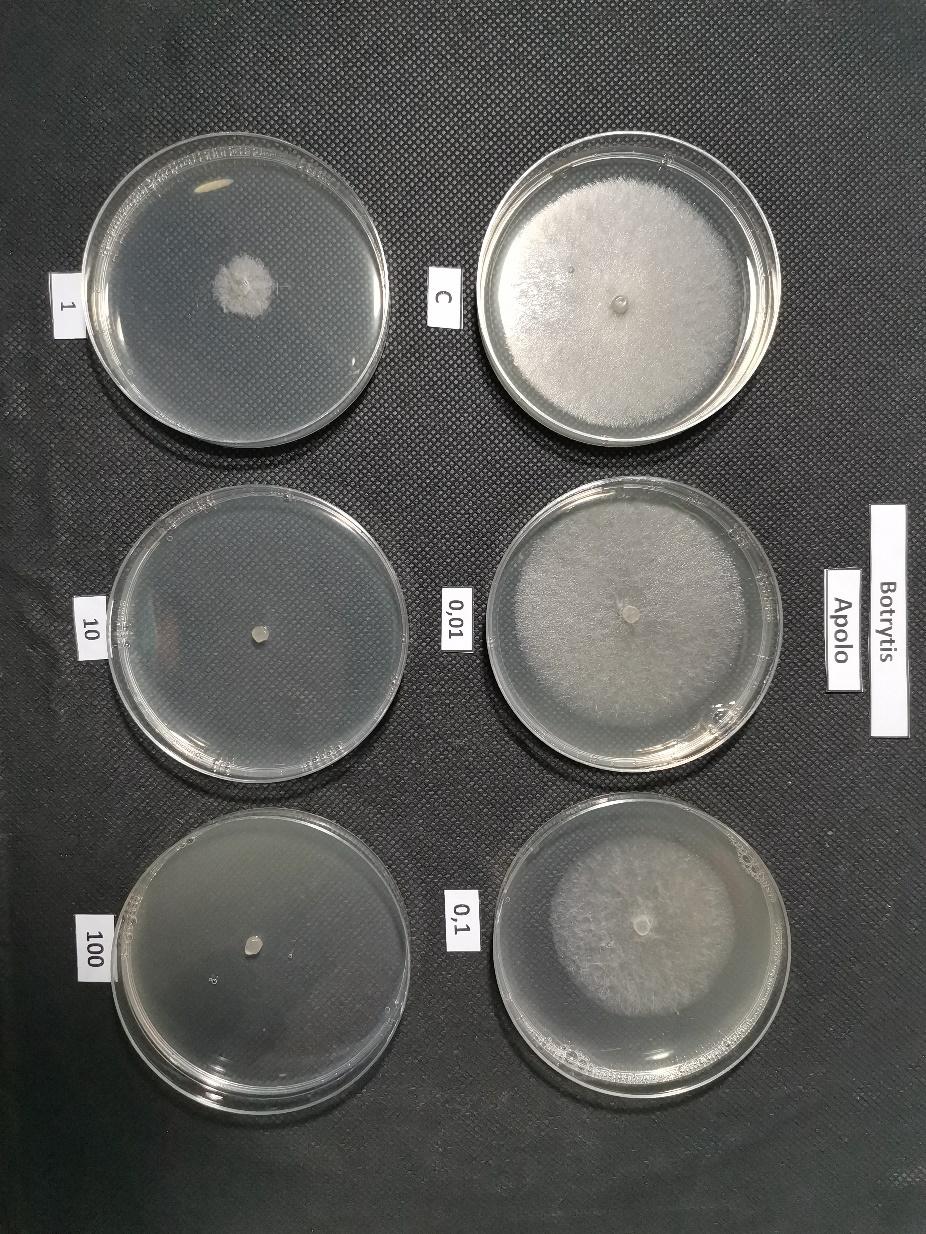
The task, then, is to maintain these good levels of sensitivity, with programs that vary modes of action during the short application window and to alternate the use of formulations of biological origin, supporting the chemical program and, at the same time, seeking to activate defenses.
It is important in orchards where rot is constant between seasons, monitor inoculum levels of Botrytis and also evaluate the sensitivity to fungicides of existing populations, and as a final recommendation, simultaneously analyze the status of the populations of Alternaria present, which generally accompanies dry seasons.
A dry and hot spring promises low levels of inoculum, however, they must still be monitored, exceptions to the rule are sometimes common. Producing under a balanced scheme is the basis for success, harvesting at appropriate maturity, without bruising or damaging the fruit, reduces the chances that the little inoculum that is in the orchards can generate an infection; the rest is in the hands of the post-harvest, where as we discussed in the previous article, the idea is to maintain in perfect condition, but it will not improve susceptible or already infected fruit, it will only contain within certain limits.