By: Walter Masman, Agricultural Engineer, Cherry Production Advisor.
Carlos Tapia T.Agronomist M. Sc., Specialist in cherry production, Technical Director Avium / Pomanova Corporation
The new cherry season is underway and the market is already preparing to address the large production that our country exports and that grows strongly every year. However, this exponential increase in so much supply is determining an economic trend in the market that the best prices are obtained by those varieties that manage to reach the Asian market first or pass the peak supply barrier. Therefore, many producers are opting for new varieties that can complement the classic ones that we all already know, which allow them to enter this race competitively and in a more profitable way. What varieties are we talking about and what characteristics do they have? Below are some of the early harvest varieties from different international programs that could soon be an interesting alternative to the conventional ones.
- SMS Program, USA.
Nimba (S2-S3)
This variety has low cold requirements (< 600 hours of cold). It is not self-fertile, but it pollinates perfectly well with Lapins and also with Pacific Red. It could become the earliest variety in Chile. In warm areas it could be harvested around October 25.
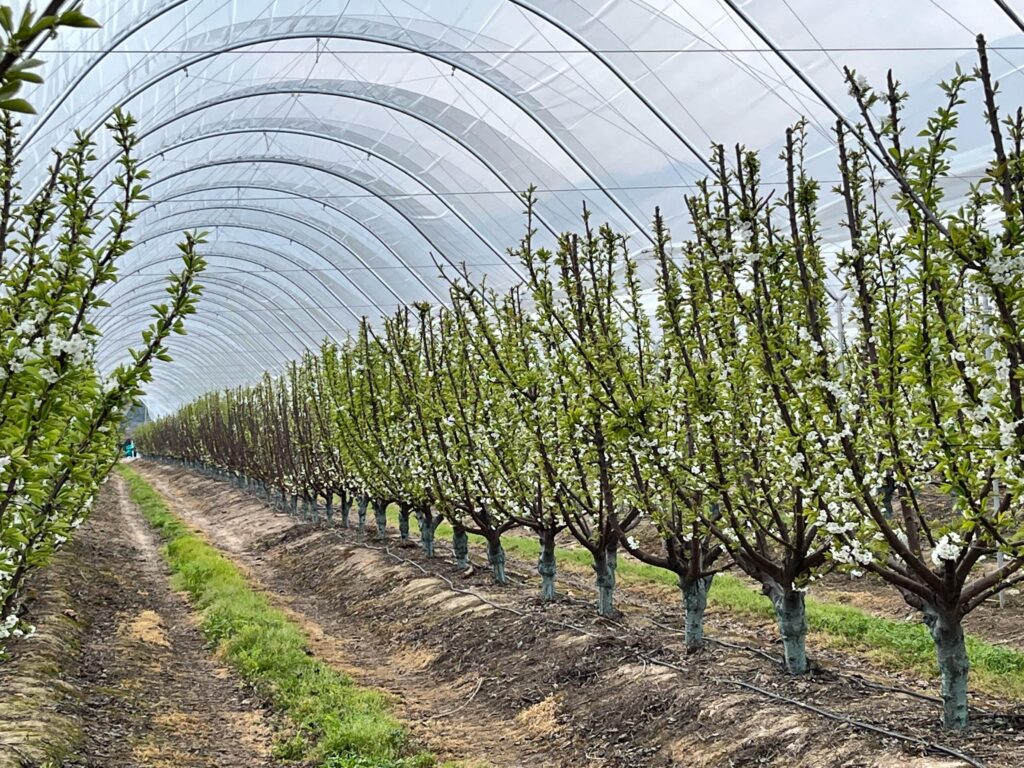
It is a variety of very good size and sweetness. However, one of its weaknesses is its sensitivity to splitting, which is why it would require covers or roofs if it is produced in places where there are problems with rain or fog.
This variety is already being marketed, although the first evaluation of the fruit in Chile was only recently carried out. It produced fruit at the base of the year's twig, which is normal for all cherry trees, but it did so in large quantities: 12 fruits per twig, compared to the 3 or 4 produced by a very productive variety, such as Lapins, at the same stage of development.
Pacific Red (S4´-S9)
Self-fertile variety, harvested immediately after Nimba.
It is very productive but of medium size, so it is interesting to see it on vigorous rootstocks to contribute to the size of the fruit.
The previous season was harvested for the first time in Chile, producing less fruit than Nimba. However, it showed very good fertility for a first year of harvest, with 3 years of planting.
Frisco (S1´-S4)
In the harvest line it is immediately after Pacific Red.
Self-fertile variety. Very good fruit producer, generally with good size and sweetness. It is harvested slightly earlier than Royal Dawn.
However, it tends to present sutures when the tree is subjected to stress conditions due to lack of irrigation in post-harvest, not very different from other varieties such as Bing and Sweetheart in the same conditions. Pedicel browning can also occur if the fruit is very exposed prior to harvest, due to lack of vigor of the tree and/or when you tend to produce a lot of fruit from the branch base. It is advisable to promote formations in which the cherries are as little uncovered as possible.
- Zeiger Program, USA.
Royal Lynn (S1-S4).
Very early variety, approximately 7 days before Royal Dawn.
Self-compatible but perfectly cross-pollinated with Lapins. Good size and sweetness.
It has been presented very early in its entry into production, even on vigorous rootstocks.
Royal Hazel (S4-S6).
Early variety from the same genetic line as Royal Lynn, approximately 2-3 days before Royal Dawn.
Also self-compatible but compatible in pollination with Royal Lynn and Lapins. Good size and sweetness.
Very similar in growth habit to Royal Lynn, early in coming into production, even on vigorous rootstocks.
- IVU Program, USA.
Meda Rex – IVU 115 (S1-S4).
Variety 10-12 days before Santina. Self-incompatible, pollinated with Lapins. Dardiferous and good producer.
Large caliber and good sweetness and firmness.
Medium pedicel size.
Meda Wolf – IVU 105 (S1-S3).
Variety 3-5 days before Santina. Self-incompatible, pollinated with Lapins. Dardiferous and good producer. Loading habit in darts and base of one-year-old twigs.
Very large caliber, even being able to find fruit over 30 mm., and with good sweetness and firmness.
Medium pedicel size.
- UNIBO Program (U. of Bologna), ITALY.
Sweet Aryana (S3-S4´).
It is an early harvest variety, and in warm areas it could be harvested towards the end of October or beginning of November, slightly before Frisco.
Good production capacity, and presents fruit of very good caliber (28-30 mm), which is extraordinary for a variety of that date.
It is a vigorous tree with a friendly growth habit and is adaptable to manage it in different management alternatives.
- JKI PROGRAM, JULIUS KÜHN-INSTITUT, GERMANY.
Floor 376
High quality fruit. Very good size and firmness, as well as having a very good consistent sweetness. Harvest date Similar to Santina.
It should be very well suited to areas with good winter cold.
- PETER STOPPEL PROGRAM, GERMANY.
D 021 and B 062
These varieties begin to grow approximately on the Royal Dawn date, however, they allow for a different product to be offered, with fruits of good size and extremely firm, aiming for very good post-harvest behaviour. Thanks to their firmness and size, they should be better positioned than Royal Dawn.
- CORNELL UNIVERSITY PROGRAM, USA.
Black Pearl (S4-S13).
Self-incompatible variety, pollinated with Lapins or Sweetheart.
Harvest date similar to Santina, but with a better fertility and productivity potential than it. It produces firm fruit, but it takes time to reach larger sizes. “Therefore we return to the same thing: regulate loads to avoid having very small fruit.”
- IFG PROGRAM, USA.
Cherry Treat
It stands out because it is a fruit of good size, very consistent, firm, with a flavor and consistency very similar to Bing.
Early harvest date approximately just before Santina.
The commercial benefits of a variety that can be harvested from week 41 are very clear, even considering air transport. However, with the volume on the rise, and when shipments increase, fruit will probably have to be sent by ship. For this reason, the performance of varieties, especially early ones, must be such that they can be transported by sea with a safe post-harvest life, which is and will be even more of a determining and differentiating factor in the future.
One of the great challenges that is important for producers to define and understand is that when they opt for this trend of new varieties that are outside the peak of supply, they must prepare even more in terms of guaranteeing the quality of the post-harvest fruit. An early variety with a limited period from flower to harvest cannot be required to have the same volume, sugars, consistency and post-harvest performance as a variety that comes out in December. It is a bet that carries risks as well as profitability. There is a fine line between the market questioning the variety for its characteristics rather than for the date on which it arrives. It is essential to carry out exhaustive research on the performance of the variety in the face of the orchard scenarios that the producer has and the way to also guarantee its post-harvest performance.