In two previous articles we addressed climate change as a phenomenon and how it is affecting cherry production, as well as the challenges involved in continuing to produce this fruit species in the midst of floods, unstable springs and heat waves, such as the one expected to be generated by “El Niño” at the end of spring and during the summer season. On this occasion, in the third and final article of the special climate change, we will address possible solutions or alternatives that contribute to continuing with this crop, despite inclement weather.
Technology is presented, as the title of the article points out, as the lifeline of cherry production in the face of climate change; and this fruit species is one of the most delicate. It requires certain processes linked to the climate to occur in order to reach the expected productive potential; of course, there are agronomic managements that can be carried out to “help” the orchard in certain processes, but even, for example, the application of dormancy breakers, requires a certain compliance with cold hours (at least 70 percent of the required HF).
The scenario during the current season has been complex: intense rainfall and flooding in winter, low accumulation of cold hours during dormancy and an unstable spring are some of the phenomena generated by climate change. All of these present complex situations when it comes to producing cherries, to which could be added rainfall late in the season, with fruit already on the trees, which could literally be the “icing on the cake”.
“Fortunately, we have more and more technological elements, tools as we call them, to be able to mitigate, for example, climate stress. We know that climate stress is going to be more and more aggressive. If you look at the climate change vulnerability map, Chile is a country where the climate is going to change very quickly, so we have to be prepared. The worrying thing is not that the climate will change, but how we can adapt to climate change.” says Prometeo Sánchez, Research Professor at the College of Graduate Studies in Agricultural Sciences of Mexico.

Climate change is a reality and in the face of it, cherry producers need to gradually adapt to this new reality. This has become evident during the current season, where due to flooding and soil oversaturation, the start of the irrigation season has had to be delayed, for example; at the same time, the application of nutritional, fertilizer and phytosanitary programs has also had to undergo adjustments, since, as many specialists have pointed out, “This is a season in which we must constantly monitor the orchards to make certain adjustments.”
“I am concerned that many producers continue to do the same thing with different climates. When we have “Niño” years or “Niña” years, the weather conditions are different, so we cannot continue watering, fertilizing, and managing pests as usual. The climate is a determining factor for the absorption of water, nutrients, and for the dynamic control of pests, so we have to learn to adapt to the climate. We can sustainably manage the plant in such a way that we can mitigate this stress. There are many products on the market (…), or technological tools that we call them, that we can use depending on the type of stress.” Prometheus Sanchez warned.
A concern in the garden

For several years now, water shortages and high temperatures and radiation in summer have been part of the concerns of cherry producers. Although each season is different and has its own challenges, the current campaign has put cherry production to the test.
“We have had problems in differentiating flowering due to the cold hours and we are waiting for them to give us water to be able to start watering, especially in the earliest areas; because of the flooding, in fact in the fields in the south we have a lot of problems, especially in the Maule area, in fact I think that after October 20 onwards we may only start to have water” commented Cristian Valdés, Engineer at Agrícola Innova Holding Gold Anda.

This conglomerate owns cherry orchards, packing plants and also exports this fruit species; they have cherry trees from Putaendo to San Clemente, of the Lapins, Regina, Santina and Kordia varieties. According to Valdés, technology is essential to confront climate change in agriculture.
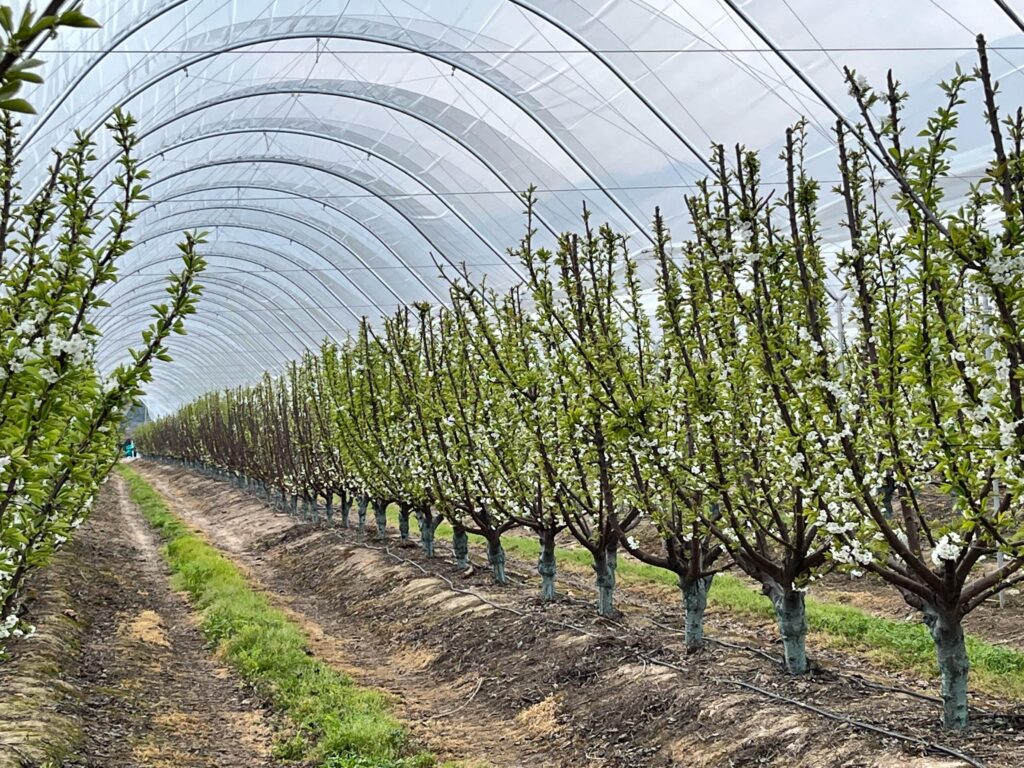
“Technology comes hand in hand with cherry production, starting with applications, management and overall complete production; we are also doing projects with cherry trees under roof, automated, irrigated directly with technology and it is a fundamental tool to produce, not only volume, but also excellent quality of fruit, because the cherry over time will not be based on volume but will only be good quality fruit, good sizes and good colors,” closed by Cristian Valdés.
Westfalia Fruit Chile, for its part, has cherry orchards in the central region of Chile and in Río Bueno, in the south. Tomás González, Head of Machinery Operations for the company, told us about the main concerns that this season has generated regarding climate change and the extreme conditions left by the “El Niño” phenomenon.
“The truth is that it has us all on edge; (we have to) manage the issue of water in the central area, the hydric stress that we are having today and also with the rains, climate change, we are having much more advanced, irregular blooms, also fungal problems, it is going to be very strong this season and, the truth is, we have to have good management and we are waiting for what may happen,” said Tomas Gonzalez.

In the central area they have Lapins, Santina and Royal Dawn varieties, while in the south the strong point is Regina, where the use of technology is essential for production.
"If we have cherries in the southern area, we must have covers, all with roofs, and also improve the pruning issue. We know that it is a variety that comes out later, so we try to focus on quality, to arrive with good cherries at the destination.“, Gonzalez explained.
When asked about the usefulness of technology for cherry production in the face of climate change, the Head of Machinery Operations was emphatic in pointing out that: “In any case, with the technology nowadays, with these multispectral images, we can see how the plant is behaving, the issue of the stomata, whether they are open or closed, the issue of irrigation and the minimum and maximum conditions we have, and now with what we have of slightly irregular flowering, possible frosts, perhaps as well.
The role of technology
As problems in agriculture linked to climate change have emerged, represented mainly in Chile by less marked seasons and a 14-year megadrought that is now hard to remember, due to the intense rainfall left by the atmospheric rivers of winter, various technological solutions have appeared.

“Currently, we are seeing adverse weather conditions such as torrential rains and high temperatures more frequently as a result of climate change. This, combined with the prolonged drought affecting the country, creates a certain degree of uncertainty regarding the availability of water resources to maintain optimal yields in cherry crops. Efficient irrigation technology can help optimize the use of available water, but to ensure the sustainability and growth of cherry production in the country, it is necessary to find new sources of water. The use of groundwater is a good alternative in different sectors. Hydrogeological studies and geophysical technology allow us to detect underground aquifers and determine their capacity to provide a sustainable source of water over time.” commented Daniel Cabrera, Executive Director of Aquadetect Chile.

Technology will undoubtedly be the main ally for cherry production in the face of climate change. Today, more than ever, it is necessary to use all those innovations that allow us to have the clearest x-ray of the crop, water requirements, climate, covers, new agronomic management, etc.
“Regarding the issue of how to deal with climate change in the cherry industry, especially in relation to irrigation, I think it is very important to think about how we are adapting from a latitude point of view, how the climatic zones have been changing in terms of production, how more extreme zones have been sought as is the case in the north, in Ovalle, how cherry orchards have grown far to the south and how today they cover a range of very different agroclimatic areas; the main thing is to understand that these differences exist and to measure, measure, measure, measure. Today we have tools that allow us to measure temperature in winter, our cold hours, our degree days, to know when we have frosts, how long and how severe they are, we have tools for frost control, for the lack of cold hours such as cyanamide and other management, we have shade tents, we have many managements that go into all areas related to how to adapt, but also how to achieve better yields, advance dates, manage to enter new areas, etc.” said Sebastián Divin, Customer Success Representative at Ceres Imaging in Chile.

Technology will make the difference and will be the main way to evaluate and define a series of aspects in cherry orchards. Through it, it will be possible to know what and how to do it, and also to evaluate the result of those operations, a tool that will positively complement on-site advice.
“Ceres and aerial images can play a fundamental role in the sense of evaluating the result of all these different techniques, of all these crop developments and also understanding a little how we can continue to improve the irrigation of cherry trees. In cherry trees there is a great challenge, especially in the case when we have mixed varieties within the same irrigation block, we sometimes have up to 4 different varieties, even different patterns in an irrigation block that have different water requirements and we can see this very graphically in our water stress images; so it is very important to understand, perhaps there are blocks, varieties, etc., that we can be irrigating differently, that we can irrigate with less water, that we can adapt to a scenario where there is less water availability, where we want to be very precise and where, in addition, we want to reduce the water footprint. These crops, in addition to constantly challenging nature, to enter that battle we have to be very precise, we have to be very fine and take advantage of all the technology we have in our hands to be able to evaluate the results,” added Divin.

For Carlos Tapia, a specialist advisor on cherry production and Technical Director of Avium, technology is fundamental, however there is another essential factor when it comes to facing climate change: “I believe that technology is accompanied by history. We live one season per year and we have little experience. Chile has 10-12 years of experience, of good experiences. In the past we were constantly learning and we have learned well, but that history is connecting past episodes, it is connecting analytics, it is understanding winters, springs, varieties. Technology will help us, but it is also history.” concluded the renowned advisor.
Avium has been conducting research on cherry cultivation for 13 years, and currently has a valuable history of the different scenarios, techniques, agronomic management, irrigation, degree-day accumulation, chill hours, phenology, among other aspects of this fruit species, which they are now combining with various technological tools; this will undoubtedly be essential to confront climate change that is here to stay.