The productive success of a cherry orchard is influenced by several factors, with temperature being a crucial element during the flowering period. Temperature significantly affects pollination and fruit set at several stages of the reproductive period, including stigma receptivity, pollen germination and viability, and pollen tube growth.
Pollen tube growth, in particular, is highly dependent on climatic conditions. Milatović and Nikolić (2013) studied the effect of three temperatures (5, 15 and 25°C) on pollen tube elongation in five cherry varieties: Bing, Lapins, Stella, Sunburst and Van. Their results indicated that the optimum temperatures are 15–25°C, at which the pollen tube manages to grow 3–5 times more than at 5°C, where growth is impaired.
In Chile, these temperatures are not always consistent during the flowering period. In fact, we have observed that in some localities, during the month of September, less than 3 days have average temperatures above 15°C, which can result in poor fruit setting. The lack of optimal temperatures prevents pollen from reaching the ovary, causing fruit abortion and, consequently, lower orchard productivity.
To mitigate these effects, the use of phytohormones such as Propulse® has been investigated. It is formulated from two auxins (2-naphthyloxyacetic acid at 20% and 4-chlorophenoxyacetic acid at 2.5%) and gibberellins (gibberellic acid at 1.0%). Propulse® has a 30-year history and was initially used in greenhouse tomatoes under the name “Tomatomone” and has now positioned itself in the fruit market due to its excellent results. It has been documented that Propulse® increases the length of the pollen tube, standing out over six other growth regulators, which would favor the fertilization of the ovules (Sotomayor et al., 2012). These results are consistent with other studies that have demonstrated the effect of auxins in various species on the elongation of the pollen tube. Based on these studies, the Propulse® approach began to be developed in fruit species, such as cherry, citrus, plum, almond, among others, proving to be an excellent and safe option, with no negative effects on their leaf area or production.
Propulse® Mode of Action
Propulse®, being an auxin phytohormone, not only promotes pollen tube elongation, but can also act as an antagonist of ethylene and its effects. It delays flower senescence, allowing them to remain viable for longer and granting a longer flowering period. A longer period of flower viability, added to pollen tube elongation, increases the chances of successful pollination, thus promoting fruit setting.
In turn, it is documented that auxins not only induce cell division in stage I of fruit growth, but also have a sink effect, favoring the mobilization of carbohydrates from the leaf to the fruit. This action complements that of gibberellins, which promote cell elongation during stage II of fruit growth. The hormonal interaction between auxins and gibberellins results in a positive shift in the size distribution curve, obtaining fruits of greater diameter and weight, and, consequently, higher yields.
What is our suggestion?
For short-period varieties, Propulse® is suggested at a rate of 16 tablets per hectolitre (16 tablets/hL) at the beginning of flowering (30 – 40% of open flowers). In contrast, for medium and long-period varieties, a rate of 16 tablets per hectolitre (16 tablets/hL) is suggested at full flowering (≥ 50% of open flowers).
Table 1. Propulse® dosage and timing of application according to varieties
| CHERRY VARIETIES | ||
| Short Period | Middle Period | Long Period |
| Santina | Bing | Regina |
| Royal Dawn | Lapins | Staccato |
| Brooks | Kordia | Sweetheart |
| Frisco | Skeena | Sentennial |
| 57 – 65 days to harvest | 66 – 75 days to harvest | > 76 days to harvest |
| 16 tab/hL IF | 16 tab/hL PF | 16. tab/hL PF |
*IF: Beginning of flower (30-40% of open flowers), PF: Full flower (≥ 50% of open flowers).
IMPORTANT: To avoid residue detection, a period of at least 60 days from application to harvest must be considered.
Furthermore, it is important to consider that the time of application may vary depending on the production objective. If the aim is to promote fruit retention, it can be applied at the beginning of flowering, with 30-40% of open flowers, without affecting the size. While, in later applications, from 50% of open flowers, the growth of the fruits is enhanced, improving the size distribution curve towards higher sizes. Therefore, the effect obtained will be strongly influenced by the time of application.
To achieve these results, it is suggested to carry out a single application in healthy and adult orchards with a wetting volume of 1000 liters per hectare, ensuring that the pH of the water is between 5.0 and 6.0 to maintain the effectiveness of the product.
Experiences with Propulse®
The effectiveness of Propulse® at these doses and application times (Table 1) has been consistently demonstrated over several years of studies. Trials carried out at various experimental stations and with the collaboration of different advisors have supported the reliability of this phytohormone.
The analysis of production (tonnes/ha) in different cherry varieties with and without the application of Propulse®, carried out in different areas and at two application times (beginning of blossom and full blossom), shows that the application of Propulse® results in an increase in production. The observed increases vary between 6% and 164% (graph 1). A greater or lesser percentage variation may be influenced by factors such as the cherry variety, the age of the orchard and the specific conditions of each location and field, as well as the conditions under which the application is carried out.

Chart 1. Production in cherry trees var. Bing, Kordia, Regina and Skeena in different locations, comparing treatments with (red) and without (orange) application of Propulse®. Where IF: Beginning of flower (30 – 40% of open flowers), PF: Full flower (≥ 50% of open flowers). Source: Rosario Evaluation Center, 2016-2017; Avium, 2018-2019; Rosario Evaluation Center, 2017-2018, 2019-2020; Innovafrut, 2021-2022.
The production increases observed in each of these orchards have been achieved by obtaining a greater quantity of fruit of larger calibre, evidencing a positive shift in the calibre distribution curve. In fact, Table 2 presents the results on the production of cherries with calibres larger than 28 mm in these same fields, demonstrating that the application of Propulse® significantly increased the percentage of fruit in these categories. This increase not only improves the quality of the final product, but also favours the economic return, since larger calibre cherries usually obtain higher prices in the market.
Table 2. Production of cherries with calibres greater than 28 mm in tonnes/hectare in var. Bing, Kordia, Regina and Skeena in different locations, comparing treatments with and without application of Propulse®. Where IF: Beginning of flower (30 – 40% of open flowers), PF: Full flower (≥ 50% of open flowers). Source: Rosario Evaluation Centre, 2016-2017; Avium, 2018-2019; Rosario Evaluation Centre, 2017-2018, 2019-2020; Innovafrut, 2021-2022.
| Treatments | Codegua 2016 | Teno 2018 | Teno 2018 |
| Bing/Gisela 6 | Kordia/Gisela 6 | Regina/Gisela 6 | |
| 16 tab/hL in IF | 16 tab/hL in IF | 16 tab/hL in IF | |
| Witness | 5,39 | 5,67 | 7,81 |
| Propulse | 8,82 | 6,02 | 9,60 |
| Increase (%) | +64% | +6% | +23% |
| Treatments | La Marinana 2017 | The Niches 2019 | Teno 2021 |
| Kordia/Maxma 14 | Skeena/Gisela 6 | Regina/Gisela 12 | |
| 16 tab/hL in PF | 16 tab/hL in PF | 16 tab/hL in PF | |
| Witness | 5,43 | 10,98 | 6,30 |
| Propulse | 16,89 | 15,66 | 11,83 |
| Increase (%) | +211% | +43% | +88% |
Therefore, a general improvement in the quality of the harvested product is observed, with a higher percentage of cherries reaching higher and commercially desirable sizes, and in turn a good arrival at destination is obtained. Propulse® has proven to have an optimal performance in post-harvest, maintaining a considerable percentage of fruits in optimal conditions (graph 2).
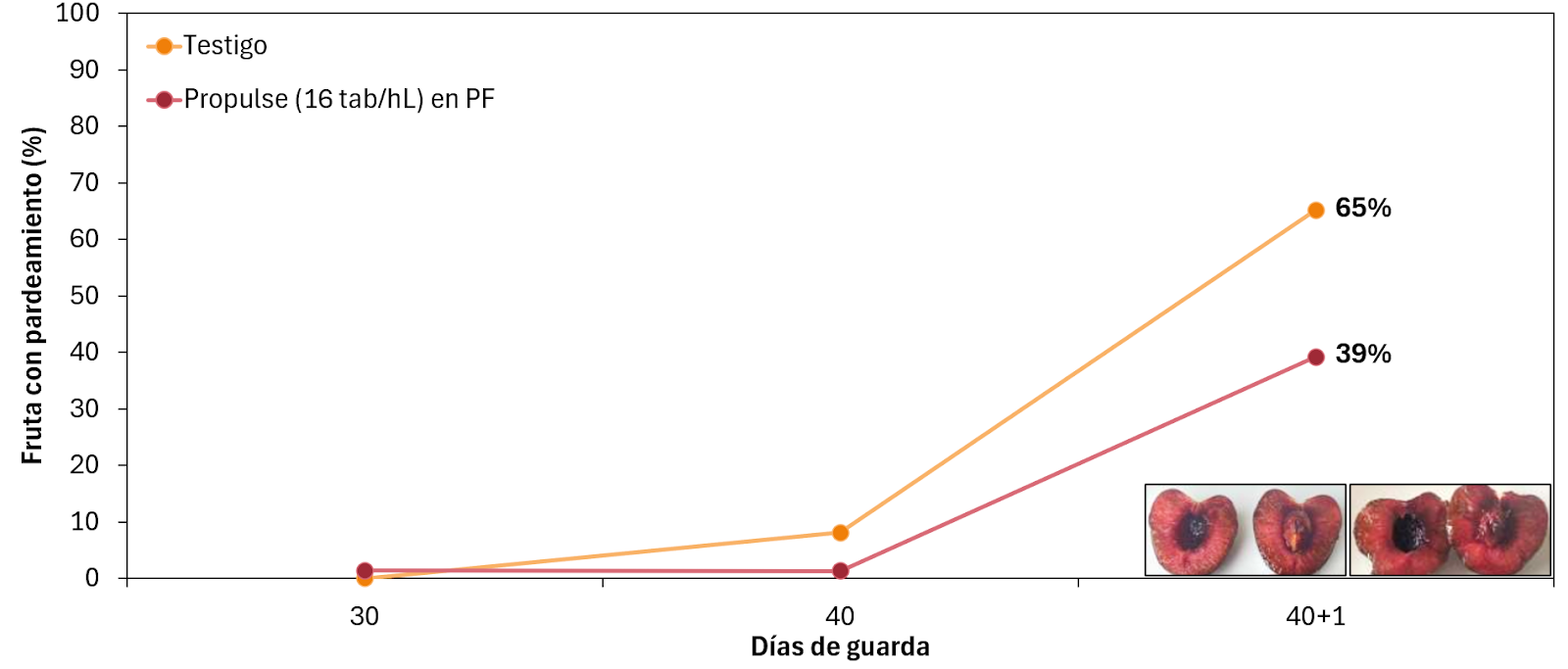
Chart 2. Percentages of fruits with internal browning at 30, 40 and 40+1 days of storage in cherry trees var. Regina in the town of Teno. The treatments with (red) and without (orange) application of Propulse® are compared. Where PF: Full flower (≥ 50% of open flowers). Source: Innovafrut, 2021-2022.
Therefore, Propulse® is presented as an effective alternative and an excellent ally to boost productive levels in cherry trees, improving both the quantity and quality of production.