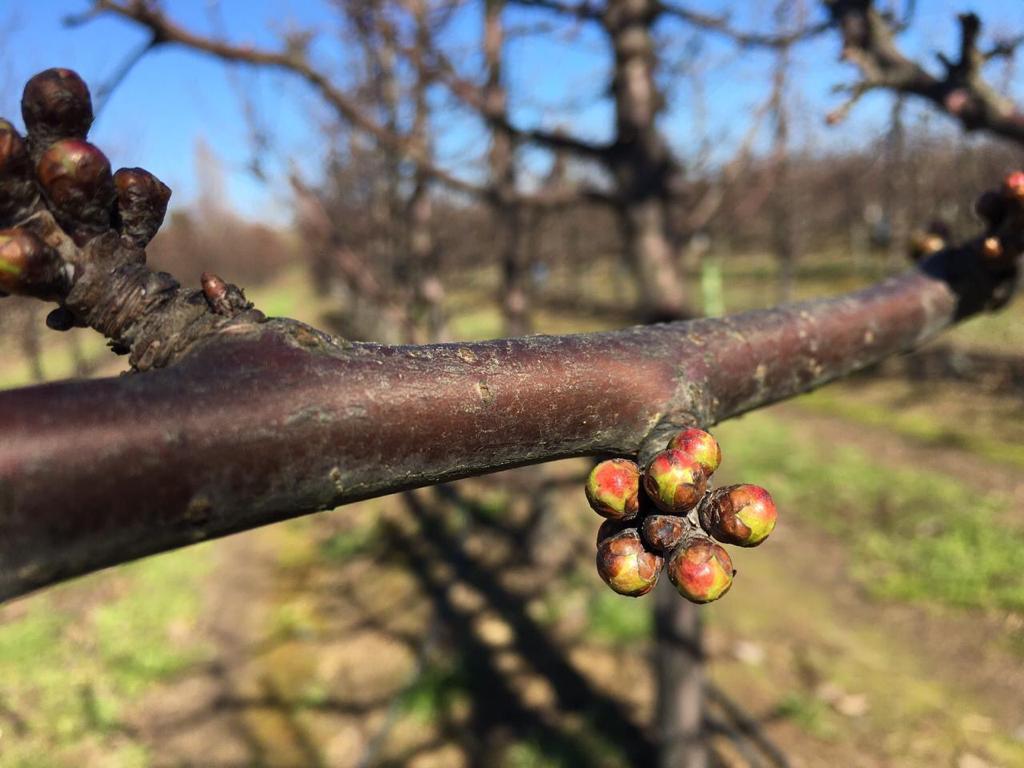
By: Héctor García, Co-Founder and General Manager of Diagnofruit Laboratories Ltda, SOCHIFIT Member.
During the 2019-20 season, after analyzing symptomatic cherry plants of various varieties, the bad news of the detection of the fungus Calosphaeria pulchella was made public, causing dieback and cancer in this fruit species. The publication made by the University of Chile working group headed by Dr. Jaime Auger in January 2021, ended up making this finding official, setting off alarm bells for an industry in sustained growth, where a new pathogen can easily compromise the sustainability of this precious crop.
The Mushroom
Calosphaeria pulchella is a fungus belonging to the Ascomycota division, Sordariomycetes class and Calosphaeriales order; I am particularly interested in describing these classification data because another fungus that causes us similar problems, Cytospora, shares the same taxonomy down to the class level, which somehow connects them; we could say that they are “cousins”. A very different situation occurs with another fungus that is often mentioned as the cause of death in various fruit species, Chondrostereum purpureum, known for causing the disease called silver blight; the latter belongs to the Basidiomycota division, which results in a fungus with very different characteristics to the first two; it would clearly be a distant relative.
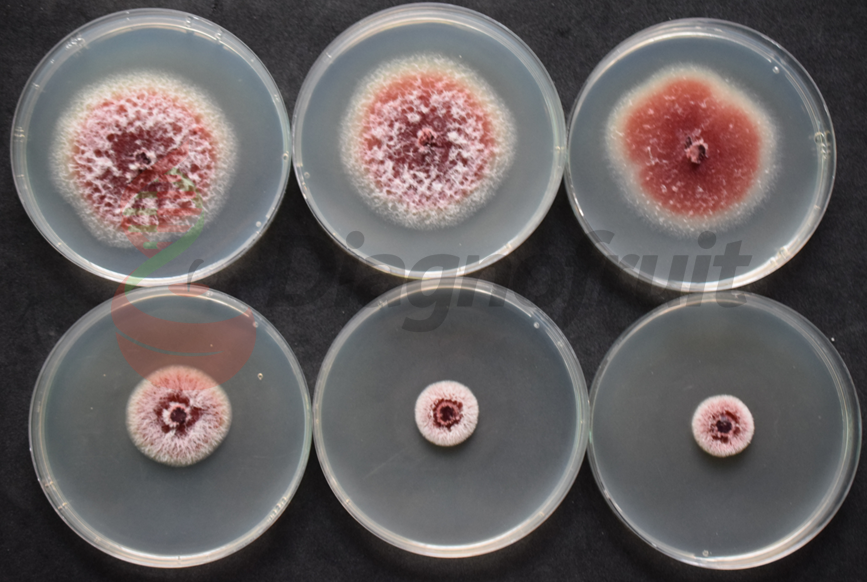
On a plate using potato dextrose agar (PDA) media we observed a very peculiar fungus, with pink to violet mycelium, tones that we can also notice in wood invaded by the pathogen.

Symptomatology
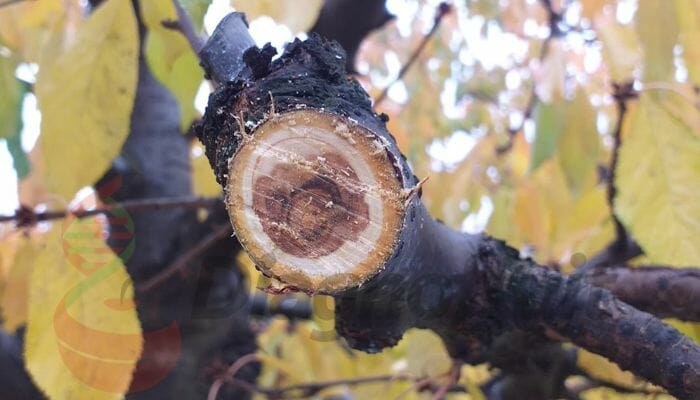
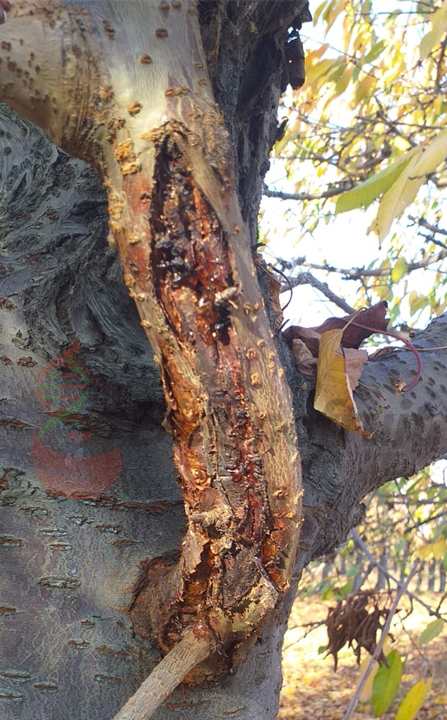
Characteristic symptoms of this disease in sweet cherry trees include dieback of the branch and main axis, as well as wood cankers and vascular necrosis (Cover Photos, 2 and 3). In general, cankers, starting from a wound, begin around the pith and develop progressively in the xylem, cambium, phloem and cortical tissues.
In the later stages of infection, cankers are noted on older branches and trunks of the main axis or stem, and are usually associated with symptoms of branch dieback and extensive leaf desiccation.
Calosphaeria pulchella may produce circinate clusters of perithecia beneath the periderm of infected branches and trunks.
The severity of the disease is high, the loss of plants can generate partial or total unproductivity of the plot as it progresses season after season.

«Control«
As the subtitle indicates, we speak of control in quotation marks, because strictly speaking, under current knowledge, successful control of the disease in an infected plant is very unlikely.
Therefore, everything related to management should aim at prevention. Starting with healthy plants (certified or diagnosed for this and other diseases) is probably the first big step. Diagnosing effectively and early (Cytospora, Pseudomonas among other pathogens share symptoms with Calosphaeria), removing sick plants, controlling stress, aiming for plant balance (avoiding excess nitrogen) are measures that appear to be the most relevant to keep our gardens healthy. Removing pruning remains or cleaning “surgeries” is essential to reduce the spread of this pathogen, since Calosphaeria generates its reproductive structures from this material that release millions of spores when humidity and temperature conditions are favorable, which preferably occur in spring and autumn, although they can occur throughout the year.
A study conducted in Spain answers an eternal question: can pruning tools spread the disease? The research published in 2018 indicates that pruning with non-disinfected scissors increased the incidence and severity of the disease, compared to the use of disinfected scissors. The results of the various treatments were consistent for both winter and summer pruning. Literally, these findings would confirm that: “Frequent disinfection of pruning tools is recommended for effective management of canker caused by
Calosphaeria”.
A very valuable strategy, but one that producers generally do not take seriously, is mapping the
orchard in order to establish the progression of the disease over time; this is the only way to know if the pathogen is twisting our arm or if it appears only sporadically and erratically, which would mean that my preventive measures would be working.
Research on Chilean populations of Calosphaeria
At Diagnofruit in 2020, we carried out studies on Chilean isolates rescued from the Region
O'Higgins with the aim of establishing their sensitivity levels to various fungicides, thinking of eventual uses for prevention at critical times, for example, spraying after pruning. Active ingredients such as captan, benomyl, pyraclostrobin or mixed formulations such as difenoconacol&azoxystrobin, tebuconazole&fluopyram, were subjected to in vitro sensitivity tests, resulting in EC 50 less than 0.5 ppm, which would indicate high levels of sensitivity in the populations analyzed. In the field, this type of fungus would generate few life cycles during the season, so it is more difficult for them to create resistance than other groups such as Botrytis or Alternaria where the cycles are many in a short time. However, this seems like good news loses strength, because the opportunity for control is a subject that has not yet been elucidated, so the effectiveness of an application program for Calosphaeria and other wood fungi remains in question.
At the last congress organized by the Chilean Society of Phytopathology (Book of Abstracts), 5 papers were presented that focused on Calosphaeria, which is evidence of the importance of the pathogen and the associated disease not only in cherry trees but in the entire range of stone fruits that are produced in Chile.
The first of these works showed that formulations, at the prototype stage, of mixtures of different species of Trichodermas and Bacillus could have a biocontrol effect on the pathogen in controlled field trials.
A second study aimed to determine the sensitivity of local populations of Calosphaeria to various fungicides, considering copper. Copper oxychloride and copper sulphate were analysed, establishing average EC 50 values of 716 and 583 ppm respectively, which could be interpreted as high levels, therefore, the populations would be little sensitive to copper fungicides, at the same time meaning that a preventive strategy for Pseudomonas control is not a great contribution to the prevention of this fungus.
The third study aimed to characterize the susceptibility of different cherry varieties to Calosphaeria. Within the varieties tested, there were no significant differences in terms of the aggressiveness of C. pulchella, the progression of the disease was similar in Santina and Regina; which establishes a high risk for the sustainability of the crop in Chile, since these cultivars are the most planted in Chile, together with Lapins.
A fourth study studied the epidemiology of this and other pathogens of cherry wood, studying aerobiological patterns of the fungi in order to detect the moments of maximum spore release. As in studies carried out abroad, the highest levels of inoculum in the environment were detected during rainy periods, which occurred in the area studied, Ñuble, between June and October.
A fifth and final study aimed to determine the prevalence and pathogenicity of C. pulchella in cherry and peach trees. Collections were made in commercial orchards from O'Higgins to La Araucanía, from 2020 to 2022. Of all the isolates (n=853), 48% were identified as C. pulchella; 46% in cherry, 38% in peach, and 45% in nectarine. In addition, all were pathogenic.
In conclusion, cancer and dieback caused by Calosphaeria pulchella is a disease that should keep us alert. Its aggressiveness and difficult control call us to continue research and take extreme care in the field to avoid the spread of a pathogen that is here to stay.