Residual herbicides or soil-active herbicides They are today a key tool for controlling weeds from seeds in fruit orchards, vineyards and vineyards, and are essential for integrated weed management in modern agriculture. Depending on the herbicide, they keep weeds free for a long period of time, giving them greater flexibility and thus allowing focus on the productive part of the orchard.
Since residual herbicides are applied in autumn and winter, periods of greater rainfall, they must have physicochemical properties that provide safe use, greater efficiency and do not cause damage to the fruit tree.
There are physicochemical parameters of herbicides that allow us to make a comparison between active ingredients and their phytotoxicity potential, under the same soil, rainfall and herbicidal efficacy conditions. These are parameters associated with the mobility of the molecule in the soil profile and its persistence.
The main ones are – solubility, organic carbon partition coefficient (Koc), half-life (DT50).
Solubility along with Koc of a herbicide are key parameters in determining its leaching potential, or rather its mobility in the soil.
The solubility of a herbicide is the quantity of product that enters into aqueous solution. Products that are very soluble in water are excessively mobile and can be transported in the soil profile by rain and/or irrigation, and can even reach surface or underground water bodies. low solubility, due to their greater affinity for soil, they are safer to use in fruit orchards.
The Koc of a herbicide Indicates the degree of adsorption of the herbicide to the soil. That is, the capacity of the active ingredients to bind to soil colloids. Herbicides with Koc values less than 500 mg/g have high mobility in the profile, with the risk of leaching or reaching the root zone. Herbicides with a higher Koc value will have greater retention in the soil (colloids).
Table No. 1. Solubility and Koc analysis of the active ingredients of soil-active herbicides used in fruit trees and vines.

Highly mobile herbicides in soil run the risk of reaching the plant's root system, potentially causing physiological damage and/or residue problems in the fruit, in the case of systemic products.
It is very important to know the parameters that define the mobility of a herbicide molecule in the soil, in order to take into account the measures that must be considered as protection, in terms of the age of the orchard, type of soil and time of use, so as not to be exposed to rain and possible dragging into depth.
DT50 or half-life: is a parameter that indicates the persistence of the product in the soil and corresponds to the number of days necessary to reduce the applied dose by half. It is an indicator that allows us to deduce the residual effect or activity of the herbicide over time.
Table No. 2. DT 50 levels by asset:

Alion® 500SC is also characterized by its long residual effect, which is explained thanks to the balanced interaction of the indicated parameters, plus others such as low volatility, stable to photolysis, among others, and the potent herbicidal activity of the active ingredient Indaziflam. This is because Alion® 500SC is the only residual herbicide on the market that was designed to work residually in the soil of fruit and vine plantations. Alion® 500SC has a DT50 of 150 days, after 150 days there is still 50% of the dose of the commercial product applied.
Alion® 500SC does not discriminate between mono- or dicotyledonous weeds, resistant or tolerant, annual or perennial from seed. Its active ingredient acts at the most sensitive stage of weeds, at emergence. It acts by inhibiting cellulose synthesis, a key process in the seed germination stage. This mode of action results in the broad spectrum of weed control that the product presents, even intervening with weeds that are very difficult to control for other herbicides.
Alion® 500SC has no post-emergence effect, it is a contact herbicide, which requires to be applied in a pond mixture with post-emergence herbicides, such as Round Full or Roundup Ultramax.
The safety of Alion® 500SC is concentrated in its previously widely explained physicochemical properties and in its contact mode of action.
Multiyear trials on different species, with applications one year after the orchard was established, have confirmed the selectivity of Alion® 500SC under different soil and rainfall conditions throughout Chile since 2006. Currently, the SAG resolution is expected to extend the application window to cherry, hazelnut and walnut orchards, one year after they were established.
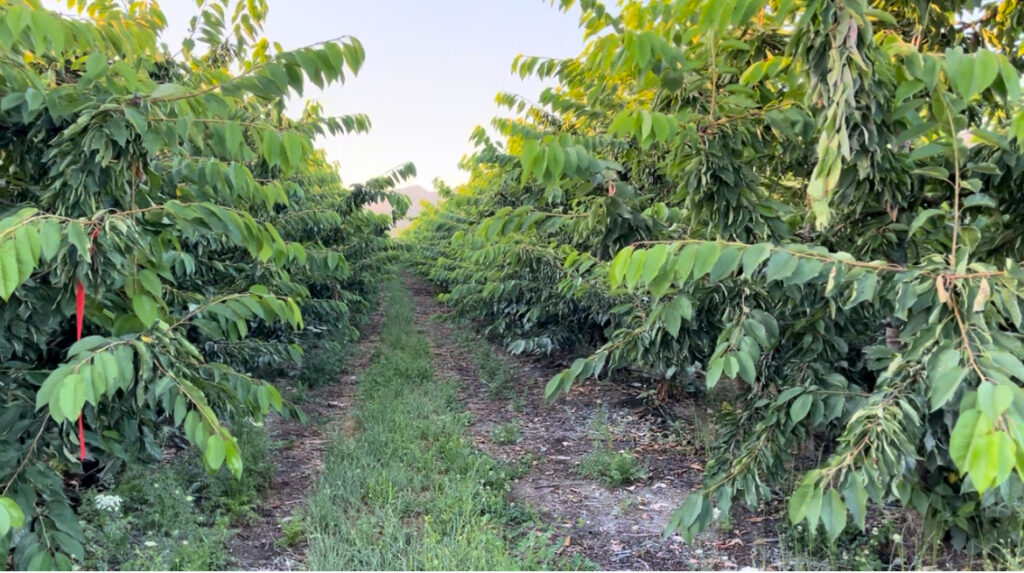
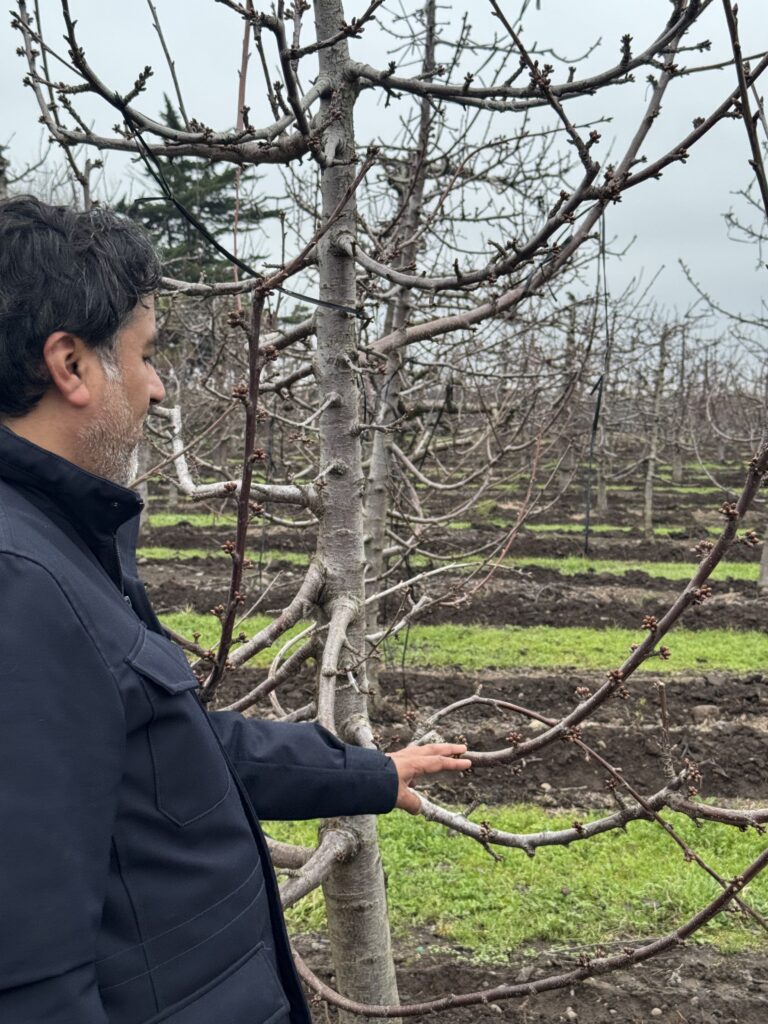
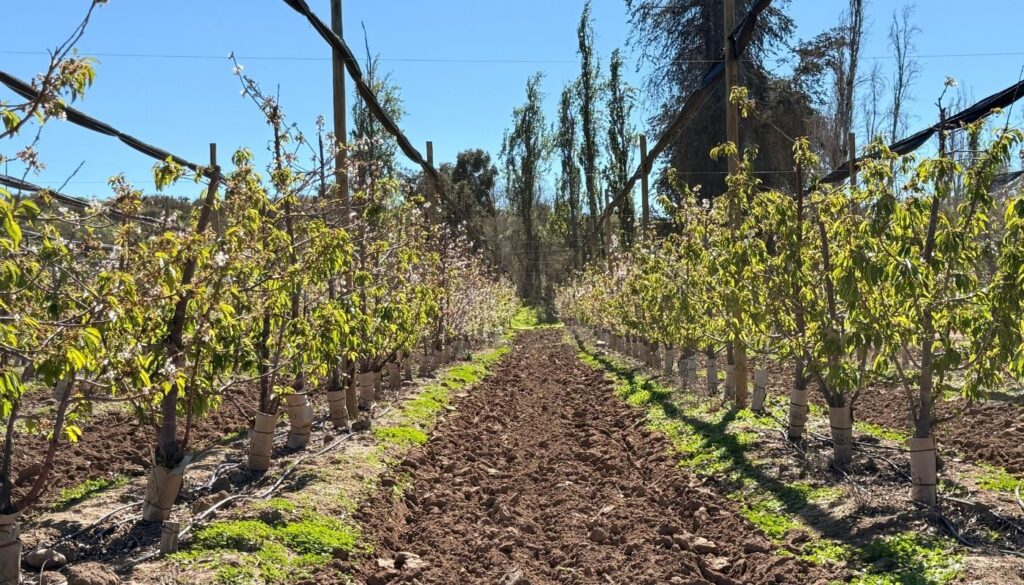
Santa Elena Agricultural Demonstration, cherry orchard planted in 2018. Regina variety over Gisella, in the town of Molina.
The application of Alion® 500SC to 200 cc/ha + Roundup Ultramax 2 Kg/ha with 200 L water/ha, carried out on July 25, 2019.
In sandy loam soil (sand 60%, silt 36% and clay 4%) with 7.4% Organic Matter.

Orchard condition on the day of application.
Condition of the orchard at different times during the demonstration trial
 Oct 4
Oct 4

Nov 8
Quantitative evaluation of trunk diameter in plants with and without Alion® 500SC did not present significant differences, under a technical micro-sprinkler irrigation system, confirming the high selectivity of the product.